

Learning Vietnamese When Language Goes Beyond the Lecture Hall
June 18, 2026 in News & Events
For international students at ULIS, learning Vietnamese is far more than just mastering a new language. It is a unique journey of immersing themselves into the heartbeat of Vietnamese culture. Every tone, every honorific, and every casual conversation peels back another layer of understanding about the people, customs, and daily rhythms of Vietnam. From the classroom to the streets, bridging language and culture, Vietnamese has become the very bond that connects these international students deeply to both ULIS and our country.
Learning Vietnamese from Scratch
Having traveled halfway around the world to the S shaped land, Daniela, a 23 year old from Cuba, is one such student. Currently a sophomore majoring in Vietnamese Studies at the Faculty of Vietnamese Studies and Language, University of Social Sciences and Humanities, she recalls that her decision to pursue the language blossomed from a love for Asian cultures. Through her research, she found herself captivated by Vietnam’s deep history and unique indigenous traditions. Above all, the historic, enduring friendship between Cuba and Vietnam inspired her desire to stay and build a long term connection with this country.
Yet, the path has been anything but smooth. Daniela shares that the biggest hurdle in conquering Vietnamese is its tonal system. Unlike her native Spanish, which is non tonal, Vietnamese features six distinct tones, making pronunciation a true trial. “If your pronunciation is not quite right, people will not understand you because the tone completely dictates the meaning of the word,” she explains. There were times she had to repeat a sentence over and over because the person she was speaking to looked puzzled, even though she was certain she used the correct vocabulary. It was only when a local corrected her tones that Daniela realized the word’s meaning had changed entirely.
These linguistic nuances have occasionally led Daniela into awkward but endearing daily situations. Beyond the tones, the complex web of Vietnamese pronouns presents another puzzle. Choosing between anh, chị, cô, chú, or bác based on age and social context has left the young student bewildered more than once. She vividly remembers a trip to Nghĩa Tân Market in Hanoi, where she accidentally called a vendor “bác” and was gently reminded that “cô” would be more appropriate. “I was so embarrassed at the time because I really did not mean to be impolite,” Daniela laughs.
For many international students, the real challenge lies in taking what they learn from textbooks and throwing it into the wild of real world conversations. Nora, a German student currently studying Vietnamese at the Faculty of Vietnamese and Southeast Asian Linguistics and Cultures, ULIS VNU, shares a similar sentiment. Nora previously studied Southeast Asian Studies and took Vietnamese courses back in Germany. Living and studying in both countries gave her a firsthand look at the gap between academic Vietnamese and the language spoken on the streets.
She notes that in the classroom, learners have the luxury of time to digest lectures, memorize vocabulary, practice sentence structures, and correct errors through structured role play. However, out in the real world, native speech flies by much faster and is packed with casual idioms, clipped sentences, and sentence final particles like ạ, nhé, or nhỉ. These subtle additions made it tough for her to keep pace when she first landed in Vietnam.

Nora shares her thoughts on the initial difficulties of getting used to sentence final particles in daily communication (Source: Minh Phương)
Casual chit chat and final particles remain the areas where she feels least confident. These particles do not just carry literal meaning; they convey respect, intimacy, or an open invitation to keep talking. These eye opening experiences helped her realize that learning Vietnamese goes far beyond vocabulary lists and grammar charts. It is an art of social etiquette and grasping the delicate cultural nuances of Vietnamese communication.
From Lecture Halls to Everyday Life
Mastering Vietnamese cannot be confined to four walls. It demands real world application, where culture is lived organically. A bustling morning squeezed into a market corner, the clumsy moments of ordering food at a local diner, or laughing over a glass of iced tea (trà đá) on the sidewalk with local friends, all of these turn into living textbooks. They do not just sharpen language skills. They allow learners to gradually absorb the social grace, daily rhythms, and beautiful identity of Vietnamese life.
Facing similar communication hurdles, Lei Lei, a third year student majoring in Vietnamese Language and Culture at Hanoi University, chose to sharpen her skills through real life immersion rather than sticking solely to textbooks. One of her most memorable mishaps happened during her first solo trip to a local market. Unfamiliar with how Vietnamese nouns and classifiers work, she casually asked the vendor for “a lot of vegetables” instead of “a bunch” (bó or mớ).
She recalls: “The vendor looked completely surprised and burst out laughing. I was so embarrassed because I could not figure out what I had said wrong. Once it was explained to me, I realized that classifiers are crucial for quantifying things in Vietnamese. After that day, every time I went back, the vendor would warmly teach me the exact names for everything so I could get it right.”
Alongside diving into cultural extracurriculars hosted by her university, Lei Lei believes that chatting regularly with friends and putting herself in everyday situations, like shopping or ordering food, is the best way to practice. “The most important thing I have learned is not to be afraid of making mistakes,” she says. “I always keep a mindset of daring to ask, daring to be wrong, and daring to fix it. Every slip up is just another opportunity to remember and improve.”
A Language That Mirrors Culture
The true beauty of Vietnamese lies in the fact that it does not just transmit information. It acts as a mirror reflecting how Vietnamese people view social relationships. Every greeting, honorific, invitation, thank you, or polite refusal carries its own cultural weight. Even the smallest detail in how an idea is phrased shows the level of respect and closeness between individuals.
This deep bond between language and culture comes alive for international students through hands on experiences. At the ULIS Spring Festival 2026, hosted by the Faculty of Vietnamese and Southeast Asian Linguistics and Cultures, foreign students got to roll up their sleeves and experience traditional Tet activities firsthand, from wrapping bánh chưng and receiving calligraphy to wearing áo dài and playing folk games.
According to Nguyễn Minh Tú, a freshman coordinator from the Faculty who helped organize the festival: “Hands on cultural events always get an incredibly enthusiastic response from international students. Right now, their Vietnamese proficiency levels vary quite a bit. However, when they team up with Vietnamese students for these activities, everyone finds a way to grow. Advanced students step up to help their peers, translating instructions or guiding them through the activities. Meanwhile, beginners are thrown into a natural conversational environment, which builds their confidence, sharpens their reflexes, and helps them use Vietnamese in real time.”
Minh Tú notes that while some international students were initially hesitant to step outside the traditional classroom setup, they quickly dissolved into the festive atmosphere once they got involved. The shift was most palpable during the folk games, where everyone opened up, laughed, interacted dynamically, and bonded effortlessly with their Vietnamese peers. The ambient laughter and energy throughout the event proved that experiential learning does more than just offer language practice. It bridges cultural divides and creates organic friendships between local and international students.
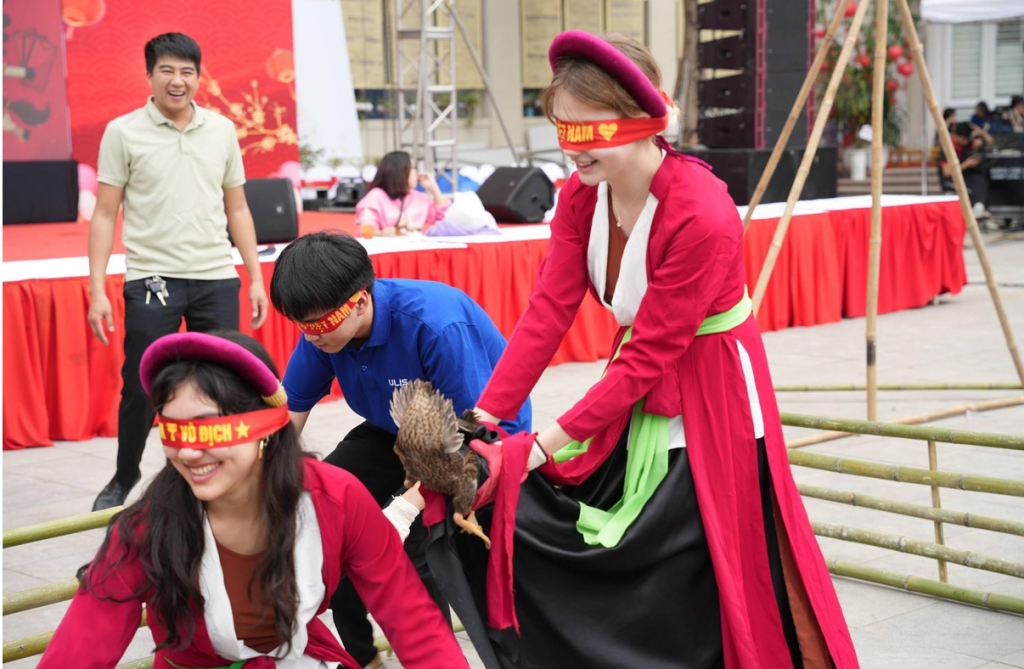
International students from ULIS VNU join the Spring Festival 2026 program (Source: Faculty of Vietnamese and Southeast Asian Linguistics and Cultures)
Dr. Trần Hữu Trí, Dean of the Faculty of Vietnamese and Southeast Asian Linguistics and Cultures at ULIS VNU, strongly echoes this sentiment. He emphasizes that “language is simply another expression of culture,” and without it, truly understanding a culture is nearly impossible. He affirms that language is the clearest, deepest path to cultural transmission. Through Vietnamese, international students do not just access vocabulary or syntax. They gain a gateway into the cuisine, customs, traditions, attire, social etiquette, and the beautifully ordinary lifestyle of the Vietnamese people.
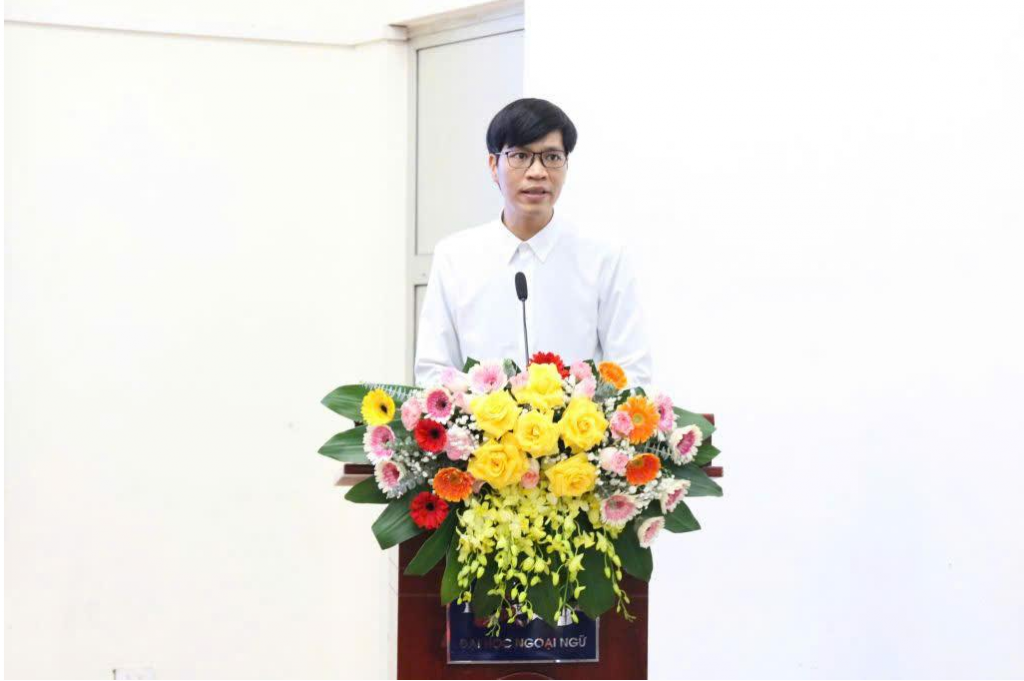
Dr. Trần Hữu Trí, Dean of the Faculty of Vietnamese and Southeast Asian Linguistics and Cultures, University of Languages and International Studies, Vietnam National University, Hanoi (Source: Dr. Trần Hữu Trí)
Ultimately, for international students, learning Vietnamese is not merely an academic pursuit. It is a heartfelt journey of weaving themselves into the cultural fabric of Vietnam. Every tone, every pronoun, and every shared conversation opens up a whole new world of understanding. From the classroom to the streets, bridging language and culture, Vietnamese has truly become the bridge that connects international students to the heart of this country.
By Giaitrivanhoa