

International Scientific Conference on “Teaching and Researching Vietnamese and Southeast Asian Languages and Cultures” 2026
The conference provides a forum for scholars and researchers to present pioneering research and applications, as well as forecast emerging trends in the teaching and research of Vietnamese and Southeast Asian languages and cultures.
On October 10, 2026, the University of Languages and International Studies (ULIS), Vietnam National University, Hanoi (VNU), held the 2026 International Scientific Conference on “Teaching and Researching Vietnamese and Southeast Asian Languages and Cultures.”
The conference was attended by Assoc. Prof. Dr. Nguyen Lan Trung, President of the Vietnam Linguistics Association; Prof. Dr. Nguyen Thien Giap, former Editor-in-Chief and Deputy Director of Vietnam National University Press, Hanoi; Assoc. Prof. Dr. Nguyen Huu Hoanh, former Deputy Director of the Institute of Linguistics under the Vietnam Academy of Social Sciences; Assoc. Prof. Dr. Nguyen Xuan Hoa, former President of the Hanoi Linguistics Association; Assoc. Prof. Dr. Nguyen Thien Nam, former Dean of the Faculty of Vietnamese Studies and Vietnamese Language at the University of Social Sciences and Humanities, VNU; and Mr. Nolan Phan, Vietnamese Language Program Director at American Councils.
Representing ULIS–VNU were Dr. Hoa Ngoc Son, Vice President of the University; Dr. Tran Huu Tri, Dean of the Faculty of Vietnamese Language, Culture and Southeast Asia; and Ms. Nguyen Thi Van Chi, Deputy Dean of the Faculty of Vietnamese Language, Culture and Southeast Asia. The conference also welcomed delegates, guests, experts, and scholars from universities across Vietnam, along with a large number of Vietnamese and international lecturers and students from ULIS.
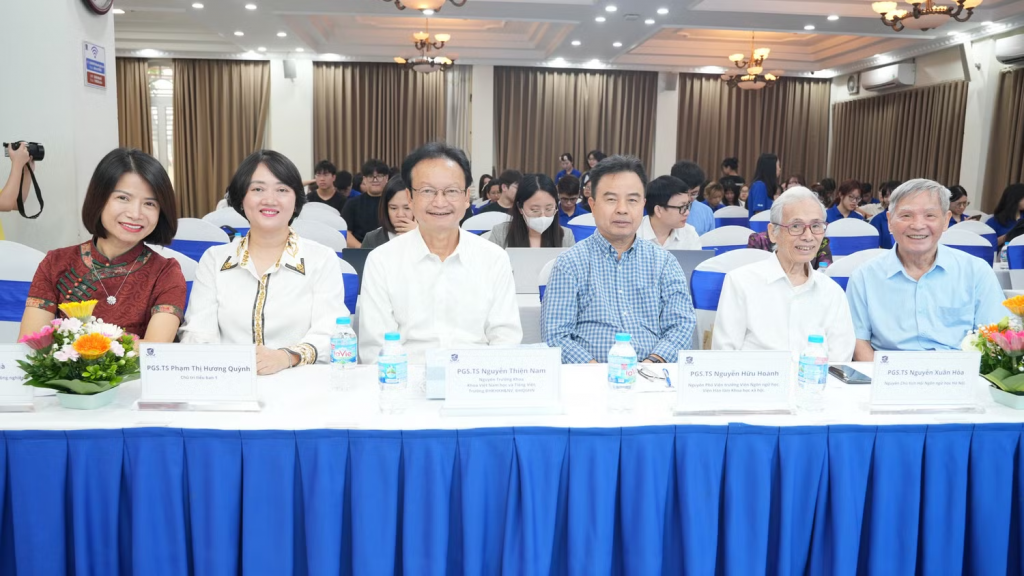
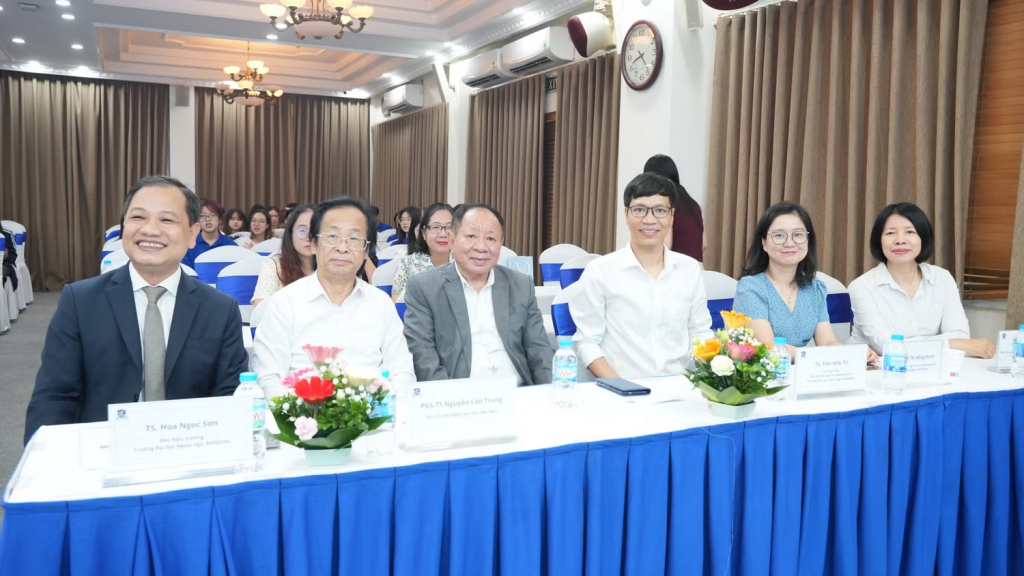
Delegates, experts, and scholars attending the conference. Photo: ULIS.
In his opening remarks, Dr. Hoa Ngoc Son, Vice President of ULIS–VNU, stated: “The 2026 International Scientific Conference on ‘Teaching and Researching Vietnamese and Southeast Asian Languages and Cultures’ aims to promote academic exchange and facilitate the sharing of research and teaching experiences among lecturers, teachers, and scholars at institutions specializing in the teaching and research of Vietnamese and Southeast Asian languages and cultures, both in Vietnam and abroad.
“The conference also serves as a forum for scholars and researchers to present pioneering research and applications, as well as forecast emerging trends in the teaching and research of Vietnamese and Southeast Asian languages and cultures. The conference is held as part of the National Conference on Foreign Language, Language, and International Studies Research and Teaching (UNiC 2026).”
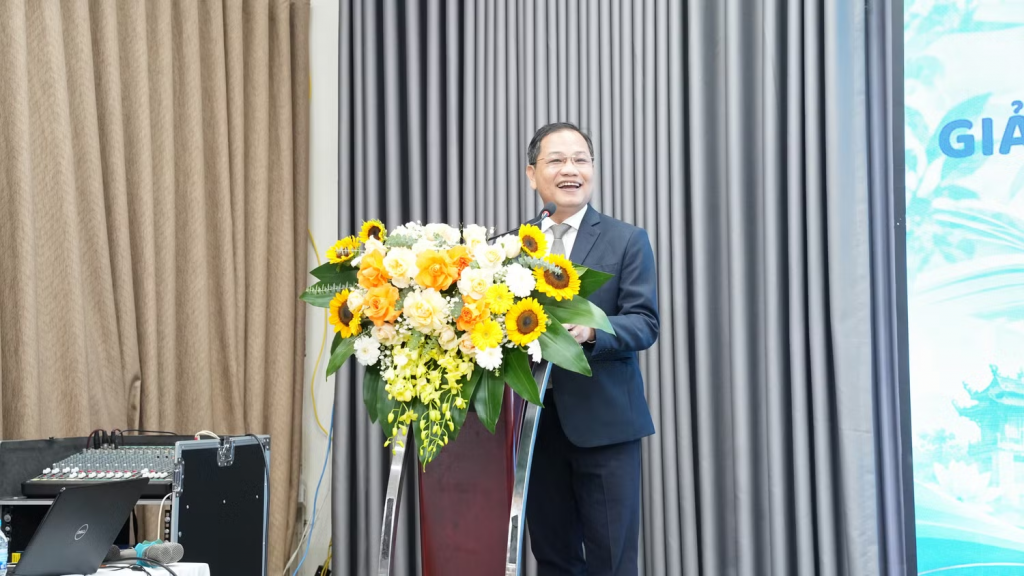
Dr. Hoa Ngoc Son, Vice President of ULIS–VNU, delivers the opening remarks. Photo: ULIS.
Presenting the keynote paper for the plenary session, Assoc. Prof. Dr. Tran Thi Hong Hanh, a lecturer at the Faculty of Linguistics and Vietnamese Studies, University of Social Sciences and Humanities, VNU, delivered a presentation entitled “Some Reflections on Teaching Culture to International Students Learning Vietnamese.”
According to Assoc. Prof. Dr. Tran Thi Hong Hanh, in today’s globalized world, developing intercultural competence is considered an essential skill for adapting to a global environment and fostering open-mindedness and empathy. Learning a language has become a journey of cultural discovery, providing learners not only with the tools to express themselves but also with the understanding necessary for effective communication.
Assoc. Prof. Dr. Tran Thi Hong Hanh outlined two approaches to teaching culture: the static approach and the dynamic approach. From the static perspective, culture is viewed as a body of factual knowledge or a collection of cultural artifacts that learners observe, explore, and learn about. In contrast, the dynamic perspective regards culture as a process, emphasizing language learning in intercultural contexts and interaction between cultures.
Accordingly, culture teaching should go beyond simply providing cultural information. It should also help learners explore and experience different cultures and develop intercultural communication competence. The choice of specific teaching methods should take into account various factors, including the curriculum, course objectives, and learner characteristics.
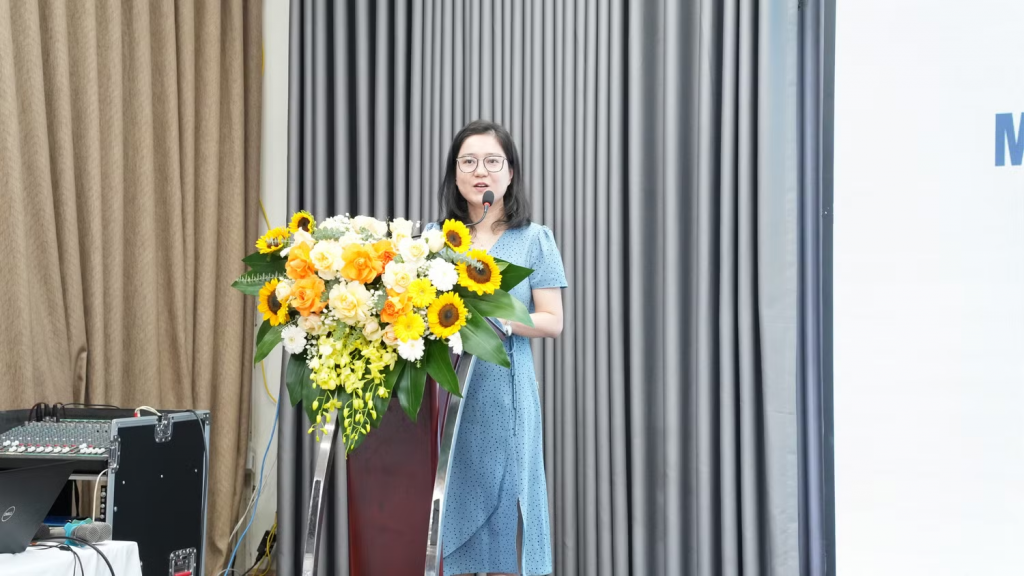
Assoc. Prof. Dr. Tran Thi Hong Hanh, a lecturer at the Faculty of Linguistics and Vietnamese Studies, University of Social Sciences and Humanities, VNU, raises issues concerning the teaching of culture to international students learning Vietnamese. Photo: ULIS.
The conference continued with a presentation entitled “Teaching Vietnamese as a Foreign Language at the University of Languages and International Studies, Vietnam National University, Hanoi (ULIS–VNU): Current Situation and Institutional Policy Directions,” delivered by Dr. Tran Huu Tri, Dean of the Faculty of Vietnamese Language, Culture and Southeast Asia at ULIS–VNU.
In terms of program development, the University introduced a Vietnamese language training program comprising six proficiency levels, from A1 to C2, in 2023. In 2025, the Teaching Vietnamese as a Foreign Language program, under the Vietnamese Language and Culture major, began enrolling students.
Drawing on its experience in implementing training programs and cultural exchange activities, ULIS–VNU is now facing the need to move beyond expanding the scale of its activities toward designing learning models with clear objectives, continuity, and stronger alignment with learners’ actual needs.
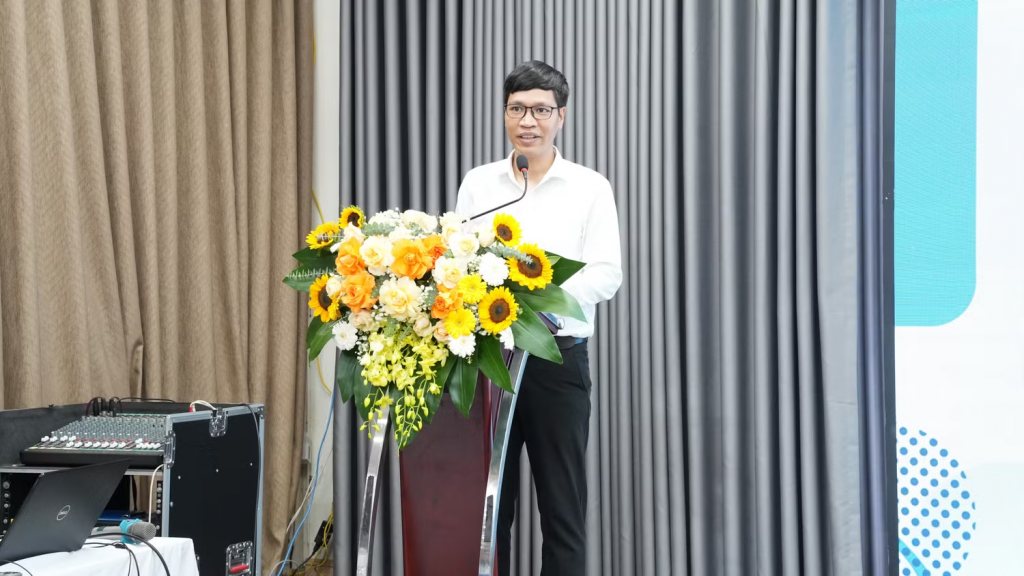
Dr. Tran Huu Tri, Dean of the Faculty of Vietnamese Language, Culture and Southeast Asia at ULIS–VNU, presents at the conference. Photo: ULIS.
“First, the proportion of cultural exchange activities has continued to increase, reaching 44% in 2025. This indicates that cultural experiences, cultural exploration, and language use in real-life contexts are becoming important components of education and training. However, for short-term programs, the challenge is to establish realistic and achievable objectives, avoid overly broad content, and offer learning options suited to different groups of learners. Therefore, the proposed direction is to design programs based on learners’ needs and proficiency levels while ensuring consistency among objectives, content, and assessment methods.
“Furthermore, ULIS–VNU currently offers an undergraduate program with 68 students in the 2025 cohort and 72 students in the 2026 cohort, in addition to short-term Vietnamese language classes. This represents not only the scale of the training program but also an opportunity to apply pedagogical knowledge and professional skills in practice. The key question is how learners can transform their specialized knowledge into practical teaching competence, for example, through teaching practice, teaching assistantships, or direct involvement in classroom situations. Accordingly, teacher training needs to be more closely connected to the practical teaching of Vietnamese rather than remaining focused solely on theoretical knowledge.
“Another direction involves extracurricular clubs and cultural experience activities. Previously, these activities primarily focused on general student engagement and event organization. Current developments, however, call for a shift toward designing purposeful communication tasks with appropriate support for different groups of learners, particularly high school students. This approach would enable extracurricular activities to become more than opportunities for recreation and cultural experiences. They could also serve as language practice environments where learners use Vietnamese regularly with appropriate support and continue their learning beyond each activity.
“Notably, the development of a digital learning resource repository and cooperation with FSEL have also created further opportunities to expand learning methods. Digital learning resources can help learners access content independently, enhance self-directed learning, and make programs more flexible. At the same time, it is necessary to strengthen interaction, connectivity, and collaboration with partners so that digital learning resources do not merely function as one-way sources of information but become an integral part of the training ecosystem,” Dr. Tran Huu Tri explained.
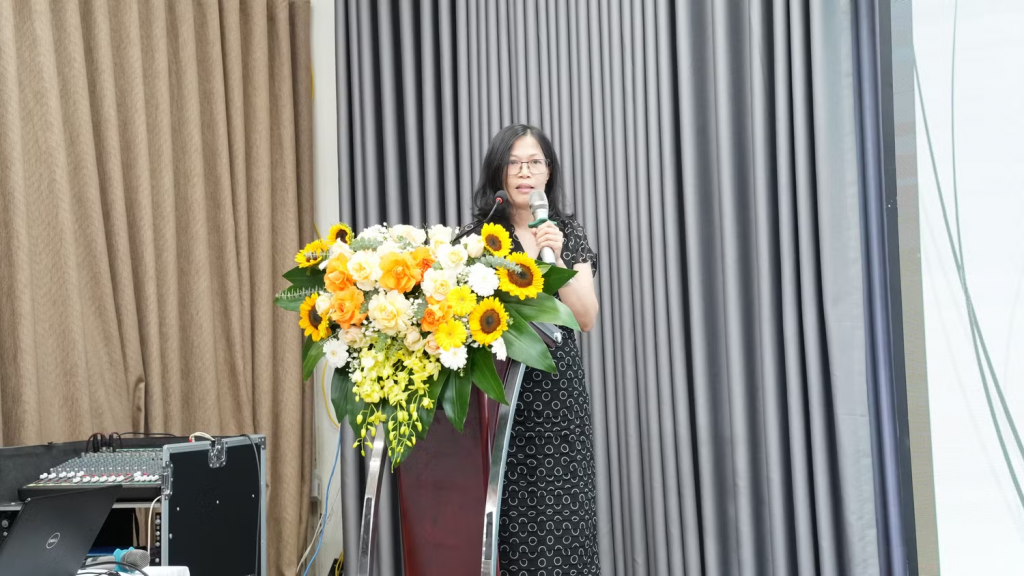
Dr. Ho Thi Thanh, a lecturer at the Faculty of Oriental Studies, University of Social Sciences and Humanities, VNU, analyzes the reasons why students at the University choose to study Thai and Indonesian. Photo: ULIS.
At the conference, Dr. Ho Thi Thanh, a lecturer at the Faculty of Oriental Studies, University of Social Sciences and Humanities, VNU, presented a paper entitled “Motivations for Learning Indigenous Languages in Southeast Asia among Students at the University of Social Sciences and Humanities, VNU: A Case Study of Indonesian and Thai Language Learners.”
Based on years of teaching experience and monitoring enrollment data, the research team observed that students tended to show greater interest in Thai than in Indonesian. To identify the reasons behind this trend and explore the motivations and barriers affecting language learning, the team conducted a preliminary survey examining students’ reasons for choosing these languages.
The survey focused on students studying Thai and Indonesian at the University. As a preliminary study, its scope was limited and did not cover all learners at other educational institutions. Therefore, the findings primarily identify initial trends and provide a basis for further, more in-depth research.
Among students majoring in Thai Studies, 34 of the 37 respondents, or approximately 92%, reported that their interest in Thai culture was a reason for choosing the language. By contrast, employment opportunities accounted for a very small proportion of responses.
Among students studying Thai within the Oriental Studies program, 119 out of 136 students participated in the survey. Of these, 111 students, or approximately 93%, reported that an interest in Thai culture was one of their motivations for choosing the language. The proportion who selected Thai because of employment opportunities was also relatively small. These findings suggest that the appeal of Thai culture may play an important role in attracting students to learn the language.
The findings for Indonesian revealed a somewhat different picture. Of the 65 students who answered the question about their reasons for choosing the language, 28, or 43.1%, reported an interest in Indonesian culture. Meanwhile, 18.5% chose Indonesian because of employment opportunities, and 33.8% cited reasons related to their studies. Some students gave other reasons or did not clearly specify their motivations.
Thus, compared with Thai, cultural factors appeared to have a considerably smaller influence on Indonesian language-learning decisions among the students surveyed. However, these findings are insufficient to conclude that Indonesian culture is inherently less appealing. Language choices may also be influenced by access to information, personal experiences, and perceptions of career opportunities.
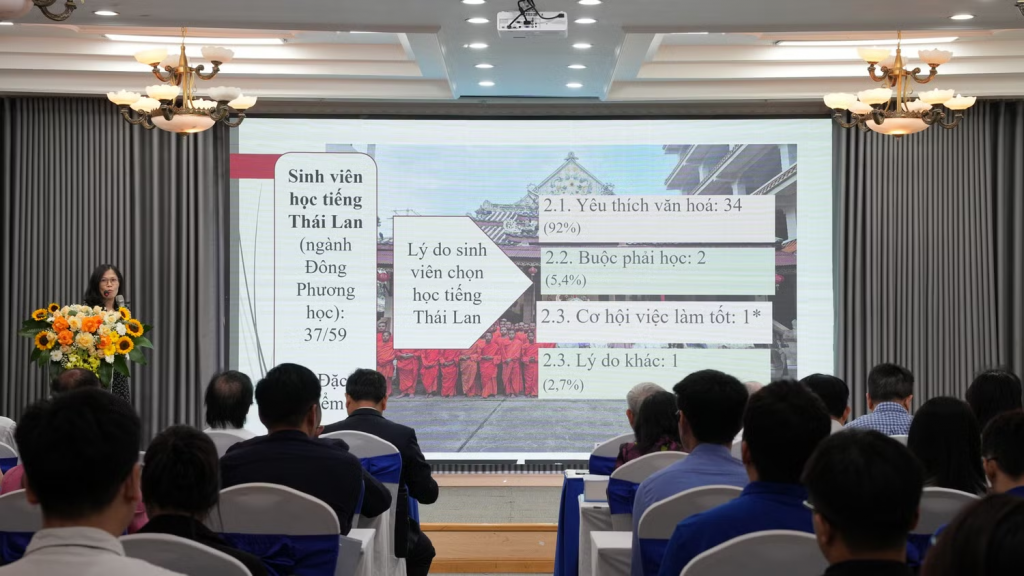
Dr. Ho Thi Thanh’s research team conducted a preliminary survey into students’ reasons for choosing a language. Photo: ULIS.
Based on the preliminary survey findings, Dr. Ho Thi Thanh emphasized that culture plays an important role in motivating foreign language learning, particularly for Southeast Asian languages. However, cultural appeal depends not only on the cultural values themselves but also on how they are introduced, promoted, and made accessible to the public, especially young people.
In practice, countries such as Thailand have established a relatively strong cultural presence in Vietnam through films, music, tourism, and cultural exchange activities. These cultural products and experiences help young people develop an interest in a country before deciding to learn its language.
Indonesian culture, despite its many distinctive features, appears to be less widely accessible in Vietnam. Through discussions with students, the research team found that some had encountered Indonesian culture through isolated programs but subsequently struggled to learn more because of the lack of information sources and sustained promotional activities.
Cultural exchange activities organized by diplomatic missions play an important role in introducing Indonesian culture. However, when such activities are concentrated on a limited number of events, their reach may fall short of their potential. Therefore, more diverse promotional approaches should be explored to bring Indonesian cultural products to students and the wider public in different localities, while also strengthening Indonesia’s presence on media platforms frequently used by young people.
This also raises a broader issue: strengthening mutual understanding among ASEAN countries requires not only political, economic, and diplomatic cooperation but also a stronger emphasis on cultural exchange. When young people have regular opportunities to engage with a country’s language and culture, they are more likely to develop the motivation to explore, learn about, and connect with that country.
Thuy Hien – giaoduc.net